When a digital platform comes to us with a web series concept, the narrative vision is usually the easy part. The real challenge is building a pipeline that can deliver episode after episode on time, on budget, and in full technical compliance.
For digital buyers and streaming services, scaling a scripted web series requires clear boundaries early on: locking technical formats, defining IP rights, and planning for international localization before the first camera rolls.
As a full-cycle web series production company, we’ve seen where these projects succeed and where they derail. This guide breaks down what platforms and producers must define before going into production — and how to keep a multi-episode pipeline running smoothly.
Quick Answer
Platforms and producers should define seven core parameters before selecting a web series production partner: target audience, technical format (horizontal vs. vertical), total content volume, budget structure, IP/licensing rights, localization scope, and strict technical delivery specs. Choosing a full-cycle web series production partner ensures visual consistency, predictable timelines, and seamless delivery across global streaming ecosystems.
What Is Web Series Production for Digital Platforms?
Web series production for digital platforms is the end-to-end process of concepting, writing, filming, editing, and delivering scripted series content engineered specifically for online consumption.
Unlike traditional television or cinematic feature films, web series content production focuses on native digital viewing habits. Content must hook audiences within the first 3 to 5 seconds, maintain high pacing, and accommodate varied device screen formats.
Today, web series production powers content for:
Subscription Streaming Services (SVOD/AVOD). Episodic drama, comedy, and anthology series built to drive monthly subscriber retention.
Mobile-First Content Apps. Short-form, vertical scripted series optimized for quick consumption on smartphones.
YouTube & Ad-Supported Ecosystems. High-volume scripted series designed to maximize watch time, monetization, and brand sponsorship opportunities.
Owned Digital Platforms. Custom video hubs created by media brands to convert external visitors into registered ecosystem users.
Why Platforms Invest in Web Series
Digital media dynamics require a constant supply of fresh content to reduce user churn and maintain high platform engagement. Scripted web series have become a strategic content asset for digital platforms due to several distinct operational and business advantages:
Predictable Audience Retention. Episodic cliffhangers and character arcs keep users returning every week, significantly lowering month-over-month churn rates compared to standalone short-form clips.
Higher Customer Lifetime Value (LTV). Sustained episodic engagement increases the overall value of a subscriber, giving platforms room to optimize customer acquisition costs (CAC).
Scalable Intellectual Property (IP). A successful first season opens immediate opportunities for multi-season series, spinoffs, merchandising, and secondary licensing deals in international markets.
Agile Content Testing. Web series allow platforms to test emerging genres, formats, and talent with smaller initial investments before committing to massive cinematic budgets.
International Localization Potential. Scripted narratives are easily adaptable for global audiences via professional dubbing, subtitling, and localized metadata.
What Platforms Should Define Before Production Starts
Before signing contracts or greenlighting scripts, platforms and buyers must lock down their strategic requirements. Missing technical or commercial specifications early on leads to costly reshoots and platform integration friction later.
Area | What Platforms Should Define | Why It Matters |
Audience | Target demographics, viewing devices, primary geographic markets | Directs story pacing, script tone, and visual style |
Format | Aspect ratio (16:9 vs. 9:16), frame rates, master audio specs | Defines set framing, camera gear, and post-production workflows |
Volume | Episode duration (e.g., 60 seconds vs. 15 minutes) and season count | Sets the baseline for budget allocation and shooting schedules |
Rights | IP ownership, territorial exclusivity, buyout terms | Prevents legal disputes and enables global licensing opportunities |
Localization | Required dubbing, subtitling languages, and cultural adaptations | Influences set audio design, script adaptations, and delivery timelines |
Delivery | Container formats, color profiles, audio stems, and promo assets | Ensures direct compatibility with digital platform ingestion systems |
Production Partner | Scope of work, technical capabilities, and production capacity | Dictates narrative quality, scalability, and delivery reliability |
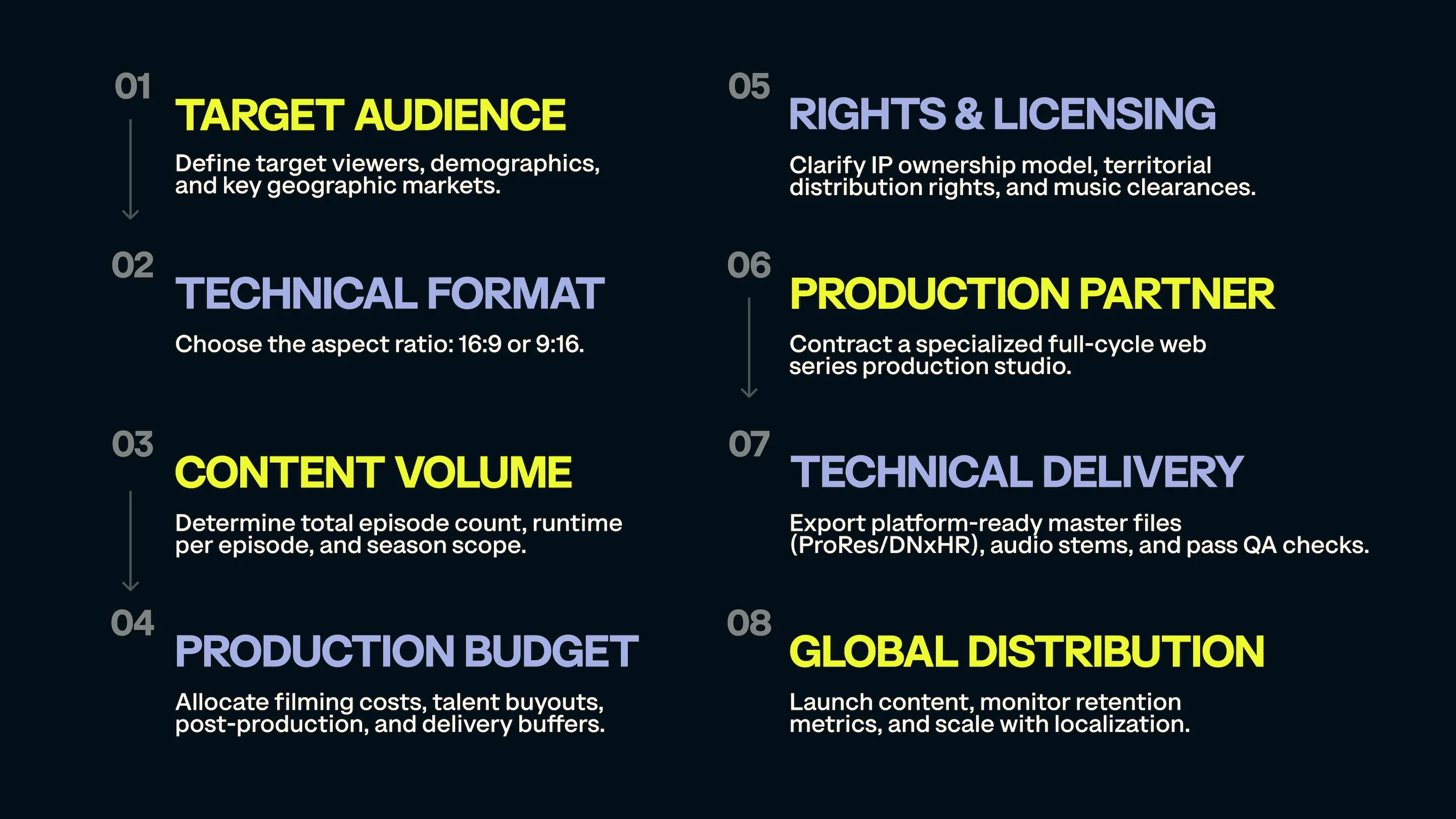
Target Audience
Understand who is watching, where they live, and how they view content. Audience demographic profile influences script pacing, dialogue density, and thematic depth. For example, Gen Z audiences watching on smartphones prefer faster visual cuts and high-stakes opening hooks, whereas desktop or Smart TV audiences expect traditional narrative setups and immersive soundscapes.
Platform and Technical Format
Determining the primary viewing interface dictates every camera setup during scripted web series production:
Horizontal Format (16:9). Ideal for OTT apps, Smart TVs, desktop viewing, and YouTube. Focuses on cinematic compositions and standard visual framing.
Vertical Format (9:16). Purpose-built for mobile-first streaming apps and social media platforms. Requires specialized lighting setups, tailored actor framing, and tight visual composition.
Episode Length and Volume
Content volume dictates the mechanics of your scriptwriting room and shooting schedule:
Micro-Dramas (1–3 minutes per episode). High episode volume (often 50–100 episodes per season), requiring rapid cliffhangers and fast-paced editing.
Standard Web Series (8–15 minutes per episode). Mid-length narratives balance character depth with tight episodic story arcs (typically 6–12 episodes per season).
Long-Form Digital Series (20+ minutes per episode). Approaches traditional broadcast television complexity, requiring larger crew footprints and longer post-production cycles.
Genre and Content Positioning
Clear genre positioning ensures your project hits specific market demands. Thrillers, romantic dramas, and supernatural mystery series perform exceptionally well across digital paywalls due to high emotional tension. Anthology series offer lower risk by presenting self-contained stories within a unified thematic framework, letting platforms test multiple creative angles quickly.
Rights, Ownership and Licensing
Clear legal frameworks protect long-term content value. Platforms must define upfront whether they are procuring an exclusive IP buyout, securing regional distribution rights, or licensing content for a fixed window. Ensure your production partner secures full talent releases, location permits, and royalty-free music synchronization rights prior to principal photography.
How the Web Series Production Process Works
A structured production pipeline ensures creative ideas are delivered on time, within budget, and to precise technical standards. A professional web series production studio manages the process across eight distinct stages:
Development & Concepting. Refining the core concept, defining target market benchmarks, setting episode structures, and locking character bibles.
Scriptwriting & Writers' Room. Writing, editing, and table-reading episodic scripts. Stories are adjusted for pacing, location efficiency, and visual impact.
Pre-Production & Logistics. Script breakdown, budgeting, location scouting, set design, storyboarding, shot listing, and crew assembly.
Casting & Talent Selection. Sourcing actors who bring visual authenticity, professional delivery, and direct resonance with the target audience.
Principal Photography (Filming). Executing camera work, lighting, direction, and audio recording under strict daily production call sheets.
Post-Production. Offline editing, color grading, sound design, dialogue editing (ADR), Foley work, visual effects (VFX), and music scoring.
Localization. Producing multi-language subtitles, dubbing tracks, and localized title cards for international distribution.
Technical Quality Control & Delivery. Final master file rendering, quality control checks, audio normalization, stem exports, and delivery of platform-ready assets.
How to Choose a Web Series Production Company
Not every video agency has the operational infrastructure to execute multi-episode narrative arcs. When evaluating a potential web series production company, platform executives should look beyond promotional showreels and assess structural production capabilities.
Episodic Content Portfolio. Verify that the studio has actual experience executing narrative continuity, multi-episode character arcs, and high-volume shot lists — not just single commercial ads.
In-House Scriptwriting & Development. A strong production company for web series should feature an active writers' room capable of refining narrative hooks and pacing to match platform retention algorithms.
Production Scalability. Ensure the studio can operate parallel filming units and manage batch shooting schedules without compromising creative quality.
Rigorous Quality Control Protocols. Check whether the studio maintains formal QA standards for video masters, audio loudness specs, color profiles, and subtitle synchronization.
Platform-Ready Delivery Track Record. Confirm experience delivering technical assets directly to major streaming systems or app-based media hubs under tight platform deadlines.

Full-Cycle Production vs Multiple Contractors
When launching a project, platforms face a choice: hire a single full-cycle web series production partner or coordinate independent freelancers and niche agencies (e.g., separate scriptwriters, production crews, post-production houses, and localization vendors).
While hiring individual contractors may appear flexible, managing multiple vendor handoffs introduces operational risks, unexpected budget leaks, and creative fragmentation.
Criteria | Full-Cycle Production Partner | Multiple Contractors |
Communication | Single point of contact (Dedicated Executive Producer) | Multiple independent contacts across agencies |
Accountability | Centralized end-to-end responsibility | Distributed liability; risk of finger-pointing during delays |
Visual Consistency | Maintained seamlessly from pre-production to post | Requires heavy oversight to avoid stylistic jumps |
Production Speed | Streamlined parallel processing & batch workflows | Slower due to handoff friction between vendors |
Budget Control | Predictable, fixed contractual budgets | High risk of cumulative cost overruns & add-on fees |
Quality Control | Single, standardized studio QA workflow | Varies significantly across separate contractors |
Delivery | Fully managed, platform-ready master package | Requires internal team to assemble and check final assets |
How to Build a Scalable Content Pipeline
Platforms scaling up their digital libraries cannot rely on slow, traditional single-episode filming models. A scalable content pipeline optimizes costs and accelerates release schedules through structured batch production techniques.
Strategic Batch Shooting. Grouping shot lists by location, set, or cast availability rather than shooting chronologically. All scenes taking place in a specific set across Episodes 1 through 10 are filmed in a single focused window, drastically cutting set transition costs and daily rental expenses.
Structured Writers' Room Frameworks. Establishing modular story outlines and clear character parameters. This allows writers to turn around episode drafts quickly while maintaining narrative continuity.
Parallel Production Units. Operating main unit photography for primary drama while a concurrent second unit captures exterior coverage, transition inserts, and promo material.
Modular Editing Templates. Utilizing standardized post-production project files, graphic callouts, sound design libraries, and color grading presets to speed up episode assembly.
Centralized Asset Management. Structuring cloud-based raw footage vaults, audio stems, graphic files, and localized subtitle files for immediate retrieval across global editing teams.
Budget Factors in Web Series Production
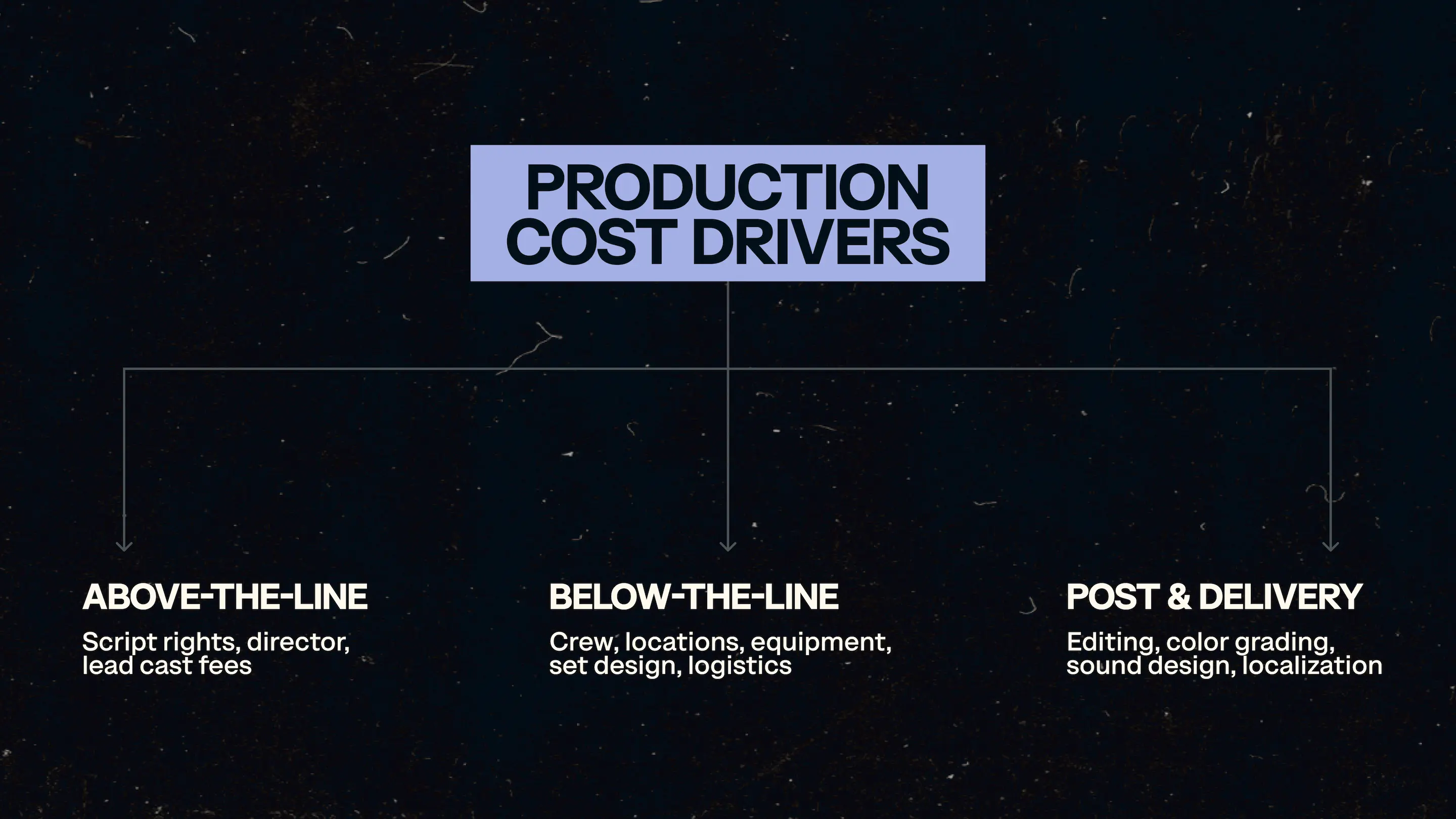
Accurate budget forecasting prevents mid-production cash crunches and ensures screen value matches platform expectations. Primary budget drivers during scripted web series production include:
Platform-Ready Content and Technical Delivery
Mobile-First Platforms (Vertical 9:16)
Require optimized file sizes, quick rendering, hardcoded visual captions (since many mobile users watch without audio), and loud stereo audio mastering calibrated for phone speakers.
OTT & Streaming Platforms (16:9)
Require high-bitrate master files (ProRes / DNxHR), strict broadcast audio normalization, uncompressed dialogue/music/effects (DME) stems for international dubbing, and standardized closed captions.
Localization and International Distribution
Localization also depends on the budget and the platform's format requirements.
Fast-Paced Mobile Content
Heavy reliance on dynamic on-screen subtitles, quick localized title overlays, and AI-assisted or streamlined dubbed voiceovers optimized for rapid multi-market testing.
Long-Form & Mid-Form Scripted Series
Full studio lip-sync or M&E (Music & Effects) track dubbing using separate audio stems, native voice casting, localized graphics replacement, and culturally adapted metadata (titles, taglines, thumbnails).
Common Risks for Platforms and Producers
Formatting Afterthoughts. Framing scenes exclusively for 16:9 horizontal screens, then attempting to crop them into 9:16 vertical edits during post-production. Result: Chopped heads, missing action, and ruined framing.
Audio Stem Oversights. Mixing music and dialogue into a single flat track during editing without saving raw audio stems. Result: Impossible to perform foreign dubbing without re-recording all sound effects from scratch.
Unlocked Script Scope. Changing scripts or adding new locations mid-shoot. Result: Destroys batch-shooting efficiency, inflates daily crew fees, and causes immediate delivery delays.
Unclear Music & Asset Buyouts. Licensing commercial tracks or stock footage for a single region instead of securing global distribution rights upfront. Result: Platforms face copyright strikes or geoblocking when expanding to new international markets.
Why Work with AMO Pictures as a Web Series Production Partner?
At AMO Pictures, we build high-performing, scalable scripted web series designed specifically for digital audiences, streaming platforms, and app ecosystems.
Here is why digital media brands, streaming platforms, and producers choose AMO Pictures as their web series production partner:
Proven Full-Cycle Execution. We manage the entire pipeline — from initial writers' room development and talent casting through batch principal photography, editing, color grading, sound design, and multi-language localization.
Designed for Digital Audiences. We understand digital viewing mechanics. Our teams write and direct content with opening hooks, pacing, and visual framing that hold viewer attention across desktop, mobile, and OTT apps.
Scalable Batch Production Systems. Our streamlined production pipelines allow us to shoot high-volume episode slates efficiently, delivering high production value while controlling per-episode budgets.
Questions to Ask a Production Partner
Before signing a contract with a digital series production company, ask these key operational questions:
Do you specialize in multi-episode narrative storytelling or standard commercial video production?
Can your team manage the scriptwriting process and run an active writers' room for our concept?
What is your maximum production capacity for batch shooting episodes per month?
Are post-production, color grading, sound mixing, and VFX included in your base quote, or billed separately?
Who retains absolute ownership of the underlying Intellectual Property (IP) and finished masters?
How do you handle localization, foreign voice dubbing, and timed subtitle exports?
What formal Quality Control (QC) standards do you enforce before delivering master files?
What is your standard production timeline from initial script lock to final master delivery?
Do you provide native platform-ready exports for both 16:9 widescreen and 9:16 vertical formats?
How do you structure production workflows to allow scalable renewal for future seasons?
Launching a high-performing web series requires more than a creative idea — it requires a dependable production system. Choosing the right web series production partner ensures your story achieves cinematic quality, lands on schedule, complies with technical specs, and drives real business results for your platform.
Whether you are building a vertical mobile series, expanding an anthology series, or scaling a flagship multi-season franchise, AMO Pictures provides the creative vision and production infrastructure needed to turn your concept into a platform-ready digital asset.
Ready to discuss your upcoming project? Explore our Web Series Production capabilities.
Share